

natscott6282
TMF Master
- Joined
- Apr 10, 2023
- Messages
- 821
- Points
- 93
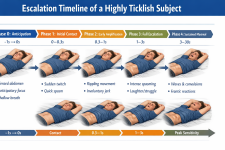
Timeline of Escalating Aversiveness During Persistent Cutaneous Stimulation
Phase 1: Initial Contact (Seconds 0–2)
Subjective experience- Immediate awareness of sensitivity
- Ticklishness perceived as sharp or startling but still manageable
- Low
- Strong desire for the stimulus to stop, but no panic
- Localized, phasic muscle contraction
- Brief directional movement toward stimulus
- Minimal whole-body involvement
- High
- Subject can remain still with effort
Phase 2: Early Escalation (Seconds 3–6)
Subjective experience- Ticklishness intensifies rapidly
- Sensation becomes intrusive rather than surprising
- Moderate
- Clear internal pressure to escape or withdraw
- Increased amplitude of local contractions
- Segmental spreading (rippling or rolling activation)
- Facial tension, breath-holding, or brief vocalizations may begin
- Decreasing
- Voluntary suppression still possible but strained
Phase 3: Loss of Comfort Threshold (Seconds 7–12)
Subjective experience- Ticklishness described as overwhelming
- Cognitive focus narrows to stopping the sensation
- High
- Strong urge to move, block, or disengage
- Oscillatory or repetitive muscle activation
- Diffuse abdominal wall involvement
- Involuntary trunk or limb micro-movements
- Low
- Suppression increasingly ineffective
Phase 4: Protective Reflex Dominance (Seconds 13–20)
Subjective experience- Sensation is no longer perceived as “ticklish” but as intolerable
- Sense of loss of control
- Very high
- Escape becomes the dominant neural priority
- Global withdrawal patterns
- Sustained tonic contractions
- Difficulty remaining positioned
- Very low
- Examination quality severely compromised
Phase 5: Reflex Saturation / Breakdown (>20 seconds)
Subjective experience- Distress rather than sensory discrimination
- Heightened autonomic activation (panic-like response)
- Maximal
- Immediate cessation required
- Chaotic or non-interpretable motor activity
- Full-body involvement possible
- Essentially absent
- Ethical and clinical need to stop
Key Clinical Insight
Aversiveness increases non-linearly.Small increases in duration or continuity of stimulation can produce disproportionately large increases in:
- perceived intensity,
- urgency to escape,
- involuntary motor output.
Summary (Conceptual Curve)
- Ticklishness: rises rapidly, then plateaus into distress
- Urgency: accelerates sharply once suppression fails
- Motor output: shifts from focal → diffuse → global
- Tolerability: drops precipitously after early seconds